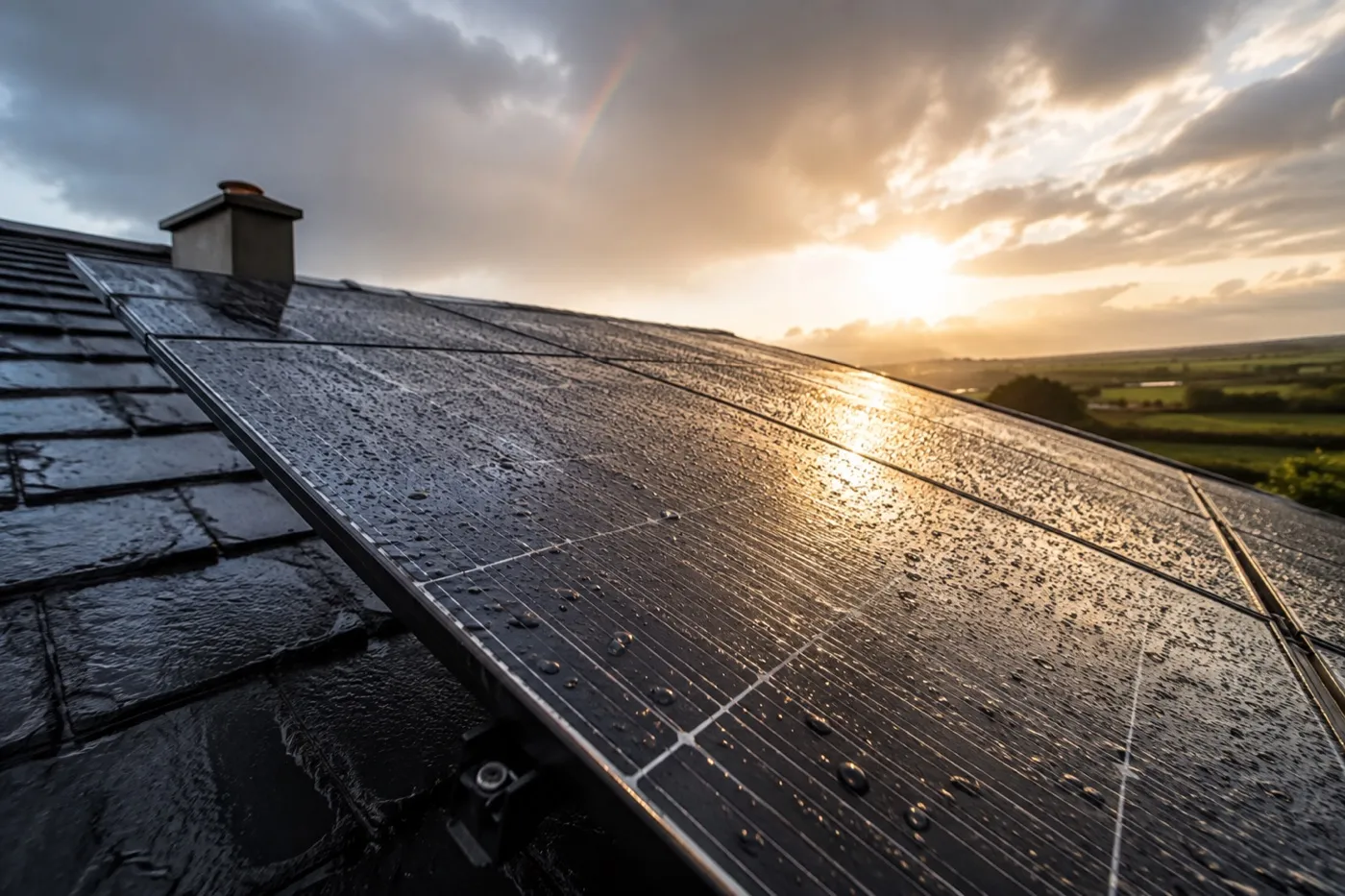
It is the most Irish objection there is: “sure we get no sun”. And it deserves a straight answer: yes, solar panels work in Irish weather, because panels run on daylight, not sunshine, and Ireland has daylight in abundance. Hundreds of thousands of Irish roofs already prove it. Here is what panels really generate through our clouds, rain and seasons, with the honest numbers.
Why the Irish climate suits solar better than you think
Panels run on daylight
Photovoltaic cells convert light, not heat or blue skies. Diffuse light through cloud still generates, which is most of what an Irish year is made of.
Cool weather helps
Panels lose efficiency as they get hot. Ireland’s mild temperatures keep cells operating near their best, an advantage scorching climates don’t have.
Long summer days
Irish midsummer delivers seventeen hours of daylight. Those long bright months do the heavy lifting of the annual total.
Rain is free maintenance
Frequent rain keeps the glass clean, so Irish panels rarely need manual cleaning to hold their output.
What a year of Irish generation looks like
The engine room. Long, bright days generate strongly from early morning to late evening, typically covering daytime usage with plenty left to export for credit.
The honest low season: short days mean a winter month can produce only a small fraction of a summer one. The system is sized so the annual total, not any single month, carries the economics.
Output dips but never stops in daylight. Diffuse light through cloud keeps units flowing, and Irish payback maths already assumes an Irish sky.
Panels are sealed units built for decades outdoors, warrantied against the weather. Rain cleans them; wind-rated mounting keeps them put.
The numbers, without the sales gloss
In Ireland, each kWp of well-placed panels typically generates around 850 to 950 kWh a year. A common 4 kWp system therefore produces roughly 3,400 to 3,800 units annually, against average home usage of about 4,200 units. That gap between generation and usage is why sizing to your own bill matters more than maximum panel count, and why the payback lands at 5 to 8 years for most homes even under an Irish sky, helped by the SEAI grant of up to €1,800.
Questions people ask
My neighbour says their panels do nothing in December.
December is genuinely the low point, and honest installers say so. The system is an annual machine: what matters is the twelve-month total, where the long summer days more than balance the short winter ones.
Would panels work better if I waited for newer technology?
Efficiency improves incrementally each year, but today’s panels already make the Irish maths work, and every year of waiting is a year of bills paid in full. The grant is available now; the weather is not the obstacle.
Do I need to angle or clean them specially for Ireland?
Standard roof pitch suits Irish latitudes well, installers optimise the layout to your roof, and the rain handles cleaning. There is no special Irish-weather regime to maintain.
Hail, frost, storms: anything to worry about?
Panels are tested against impact, frost and wind loading, and warrantied for decades outdoors. Weather resilience is designed in, not hoped for.
The bottom line
The Irish weather question has a boring answer: the technology runs on daylight, Ireland has plenty, and the yield of 850 to 950 kWh per kWp per year makes the economics work exactly as the payback maths says. The real questions are your roof, your usage and your sizing, and those are quick to answer.
If you are in Cork or anywhere in Munster, book a free assessment and we will tell you what your actual roof would generate under the actual Irish sky, no gloss needed.