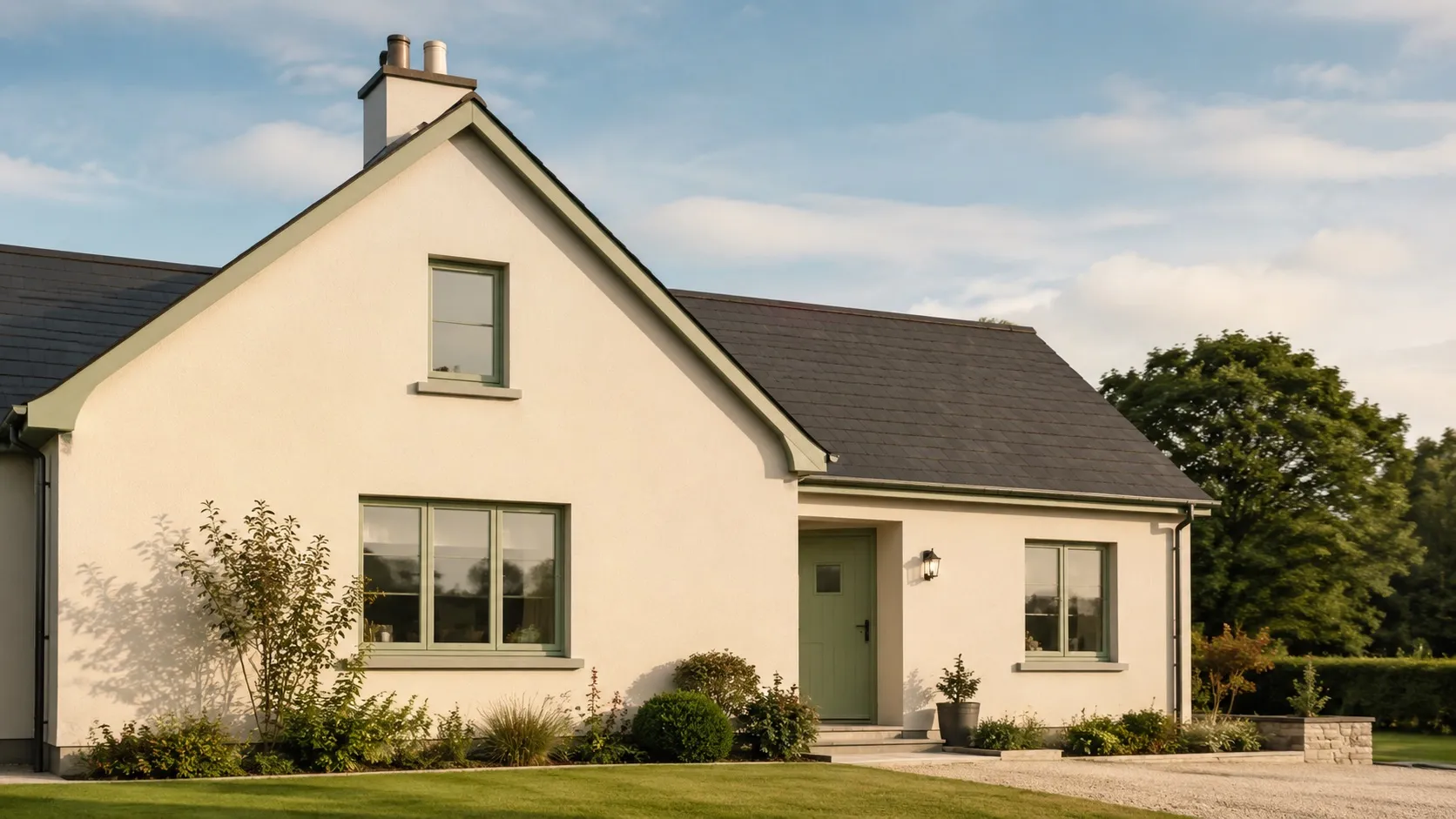
If your walls are cold to the touch in winter, you are heating the outside. External wall insulation (EWI) is the single most effective way to fix that: it wraps your whole home in a warm, weatherproof layer, refreshes the exterior, and it attracts the largest individual SEAI grant of any insulation measure, worth up to €8,000.
This guide covers what it costs, the grant by home type, how it compares to cavity and internal insulation, whether it is worth it, and exactly how the job runs.
What is external wall insulation?
External wall insulation is an insulated layer fixed to the outside of your existing walls and finished with a new render or cladding. It does three jobs at once:
- Stops heat escaping through the walls, which is where a large share of a home’s heat is lost.
- Removes cold bridges by wrapping the whole building, so there are no cold corners or damp spots.
- Refreshes the exterior with a clean, modern, weatherproof finish that can be colour-matched.
Because it goes on the outside, it does not touch your rooms, your skirting or your sockets, and it does not lose you a centimetre of floor space. That is one of its biggest advantages over internal insulation.
- What it is
- Insulation wrapped outside the wallsfinished with new weatherproof render
- SEAI grant
- €3,000 to €8,000the largest individual insulation grant
- Heat loss it targets
- ~35% through the wallsthe biggest fixable loss after the attic
- Indoor disruption
- Noneno rooms lost, no sockets moved
- Bonus
- A refreshed exteriorcolour-matched render, cold bridges removed
The SEAI external wall insulation grant (2026)
The external wall grant is the largest of the individual wall grants, set by your home type:
| Home type | External wall grant |
|---|---|
| Apartment | €3,000 |
| Mid-terrace | €3,500 |
| Semi-detached / end-terrace | €6,000 |
| Detached | €8,000 |
SEAI estimates the grant covers roughly 20 to 35 percent of the median cost, less than the ~80 percent it covers for attic and cavity insulation, simply because external wall insulation is a bigger, more involved job. See the full grant guide for every measure and the One Stop Shop route, where the grant can be netted straight off your invoice.
What does it cost, and what will you pay?
External wall insulation is a bigger job than attic or cavity insulation because it involves scaffolding, a full insulation layer and a new weatherproof render, so it costs more up front. The final figure depends on:
- The wall area and the shape of your home (a detached house has far more wall than a mid-terrace).
- The number of windows, doors and details that need reveals and beading.
- The insulation thickness and the render finish chosen.
- Any preparation needed, such as removing old pebbledash or making good.
Use the estimator for an indicative fabric figure, then we confirm the exact net cost, after your grant, at a free assessment.
Book a free assessment for your exact figure.
External vs internal vs cavity insulation
There is more than one way to insulate a wall. The right choice depends on how your home is built and what you want to achieve.
| External (EWI)Best all-round | InternalFor one room / protected facade | CavityIf you have a fillable cavity | |
|---|---|---|---|
| Performance | Highest, wraps the whole home | Good, room by room | Good value where possible |
| Disruption | None indoors | You lose access to rooms | Minimal |
| Room size | Unchanged | Slightly reduced | Unchanged |
| Cold bridges | Eliminated | Need careful detailing | Reduced |
| Grant (detached) | €8,000 | €4,500 | €1,800 |
If you have a clean, unfilled cavity, cavity wall insulation is superb value and much cheaper. If the outside of your home has to stay exactly as it is, internal insulation is the route. For most homes with solid or hard-to-treat walls that can take an external finish, EWI is the strongest option.
Is external wall insulation worth it?
For most homes with solid or hard-to-treat walls, yes. It delivers the biggest comfort jump, the largest BER improvement per measure, and it protects and refreshes the building at the same time. The payback comes every winter in lower bills and a home that simply feels warmer, and a higher BER makes the home more sellable.
It is not always the answer. A protected facade, a single cold room, or an easily-filled cavity can point to internal or cavity insulation instead. That is exactly what a free assessment is for.
The detailing that makes it last
External wall insulation is only as good as its detailing. Done properly it keeps the wall warmer and drier for decades. Good work means:
- Continuous insulation around window and door reveals to stop cold bridges.
- Correct beading, mesh and render so the finish is crack-resistant and weatherproof.
- Careful work at the roofline, eaves and damp-proof course so water is always shed outward.
- Neat reinstatement of downpipes, vents and any external fittings.
This is why it must be installed by an SEAI-registered contractor to a proper specification. The grant requires it, and so does a finish that lasts.
What the job looks like, step by step
The bottom line
External wall insulation is the strongest single upgrade for most homes with cold walls: the biggest comfort gain, the biggest BER jump, the largest wall grant at up to €8,000, a refreshed exterior, and no indoor disruption. The only way to know your exact cost and grant is a free assessment.
If you are in Cork or across Munster, book a free home energy assessment and read our complete guide to SEAI grants to see everything that is funded.